01Finding
Twice as exposed
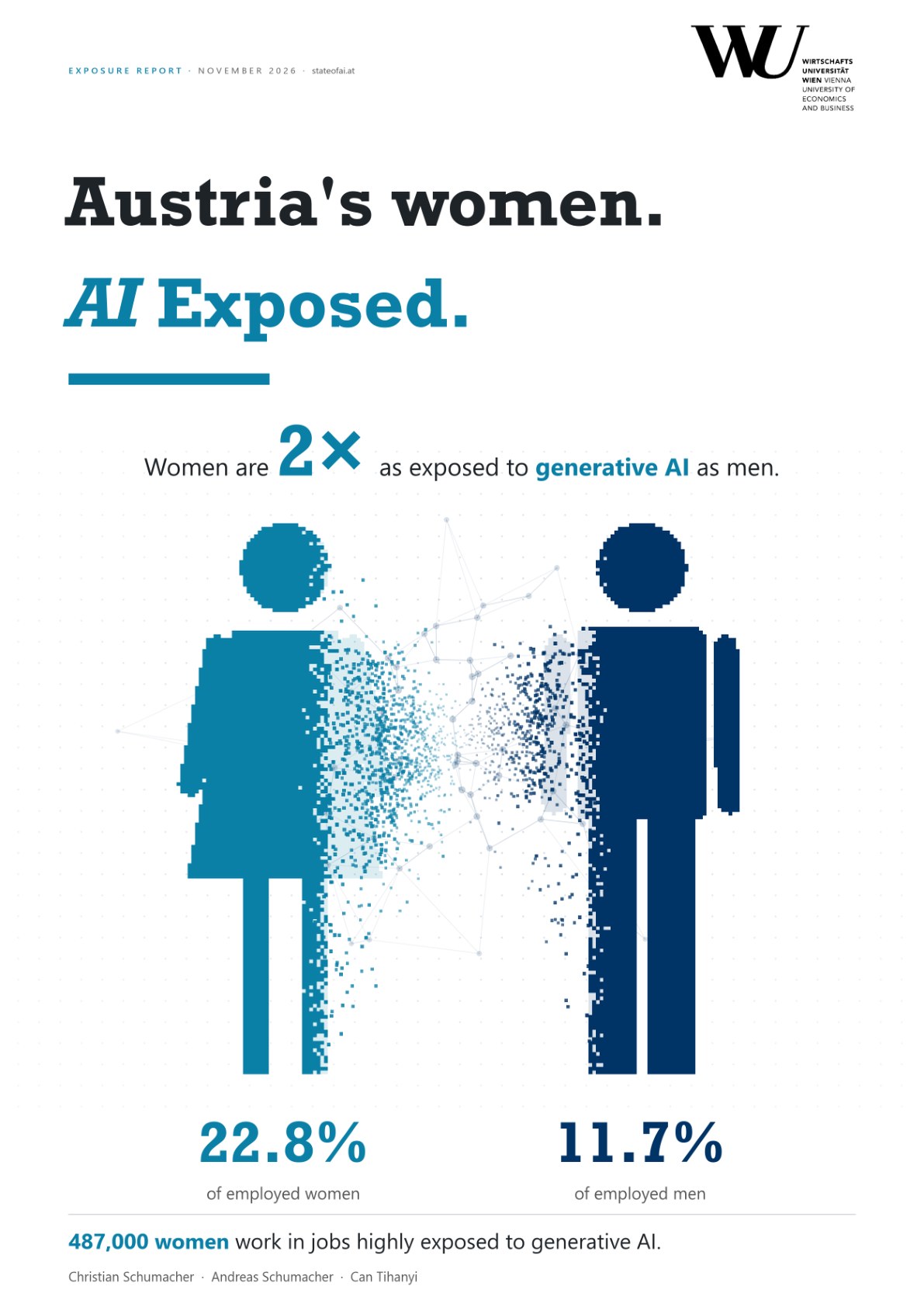
22.8%vs11.7%
of employed women vs men work in highly exposed jobs: 487,000 women and 274,000 men
Women are 2× as exposed to generative AI as men.
487,000 women work in jobs highly exposed to generative AI.
Generative AI is good at the work that fills many office days: drafting letters, summarising files, recording data, checking figures and answering standard enquiries. In Austria, women do most of that work.
About 761,000 employed people, one in six, work in occupations with a high generative-AI exposure score. Among women the share is 22.8%, among men 11.7%. The higher one sets the bar, the larger the gap: in the most exposed jobs, three in four workers are women.
Exposure is not destiny. Whether these jobs lose tasks, gain responsibility or disappear depends on employers, on demand and on policy.
Blue = women, dark blue = men. All figures 2025 unless stated.
of employed women vs men work in highly exposed jobs: 487,000 women and 274,000 men
workers in the most exposed jobs are women
of exposed women are office clerks, secretaries and assistants, or bookkeeping and payroll clerks: 381,000 women
of women work in highly exposed jobs, by education: not cleaning or care, not graduates, but the middle: apprenticeship (Lehre), BMS, HAK/HLW
of women vs men in the same office jobs hold the management or supervisory role: the part of the job that remains when AI takes over the routine
registered unemployed women in office occupations, 2022–2025, against +20% for all women
of women vs men in office jobs list an AI skill on their online profile
to act before jobs disappear
Sources: Statistik Austria labour force survey 2025; ILO 2025 exposure index; AMS open data; Revelio Labs profiles. Details in chapters 1–7 of the report.
The target group is concrete. About 487,000 women work in highly exposed jobs, 381,000 of them in three office and finance job families. Half work part-time. Public administration is the largest single setting, with 66,500 exposed women.
The risk is not only job loss. It is who gets the better half of the changed job. When generative AI drafts, records and checks, the human work shifts toward reviewing, handling exceptions, coordinating and deciding. In today's office jobs, men hold those roles twice as often as women.
The window is now. Preparing costs less now than repairing later.
Build an AI monitor. Exposure, AI talent and AI skills by sex, occupation and region: a quarterly early-warning update and an annual report, with agreed thresholds that trigger action.
A national reskilling route into jobs that need workers, for women and men. Office jobs have up to 21 jobseekers per vacancy; nursing, care, education and the trades 0.5 to 2.5. Fund the move from one to the other, open to people while still employed.
The corePublic employers go first. Public administrations apply the plan to their own staff and publish what happens to workload, roles and pay.
Bring it to private firms: routes into the office roles that stay, without pay cuts. Funded bridging courses, counselling and collective agreements carry what public employers have tested into private firms.
See where exposure sits. Map the report's exposed job families onto the firm's own workforce, with a simple heat map.
Explain the change to the people in the jobs, so that they can shape their own jobs rather than be moved around.
Give women the roles that grow. Redesign exposed jobs instead of cutting them, and give the people who did the work first access to the work that remains.
The coreMake time within paid hours to learn and to try out the new tasks, in formats that fit part-time and on-site work.
Build practical AI skills: raise the floor. Practice with the tools of the actual job, so that women master the exposed tasks and can judge when an AI output is wrong.
A report of the State of AI Research Collective.

Studies how AI changes firms, work and human decisions, using large-scale data and statistical models. Previously Copenhagen Business School, Marie Curie Fellow and Schumpeter Fellow at Harvard University.

Turns data on Austria's AI workforce into decisions for firms and policymakers. Co-lead of State of AI Workforce in Austria, ICIS 2026 author and expert at the 2026 AI Summit for Politics. Visiting positions in Tokyo, Bangkok and Madrid.

Works on industrial digitalisation, AI adoption, automation and organisational transformation. Previously managed digitalisation projects at Fraunhofer Austria; doctorate in industrial engineering at TU Wien.
The English version is the original; the German version is a translation of it.
Schumacher, C., Schumacher, A., Tihanyi, C. (2026). Austria's women. AI Exposed. Research report, WU Vienna, November 2026. stateofai.at
Christian Schumacher · christian.schumacher@wu.ac.at
A research report of WU Vienna, published for research and public information, with no commercial purpose. It continues the research programme behind Austria's AI Workforce (2026).